

Most health system finance leaders can tell you their total labor spend to the dollar. What they can’t tell you — with speed, confidence, and granularity — is where that spend is going, why it’s going there, and what’s driving the variance from last quarter.
That’s not a data problem. That’s a systems problem.
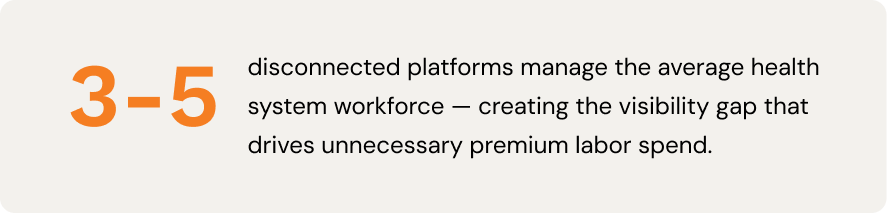
When your ATS doesn’t talk to your VMS, and neither talks to your scheduling system, every labor decision is based on an incomplete picture. The costs fill in the gaps.
The Real Cost of Fragmented Workforce Data
When systems don’t share data, the gaps between them become the places where cost hides. Consider what typically happens in a health system with disconnected workforce technology:
- A unit is short on a Thursday night. The scheduler can’t see float pool availability — that data lives in a separate system — so they call an agency. A reasonable decision, made without the full picture.
- The shift gets filled. But no one knows whether internal capacity could have covered it, because that information never surfaced at the moment it was needed.
- At quarter’s end, finance sees contingent spend up 12%. The question isn’t who’s to blame — it’s whether the right information was available at the right time. In a unified system, it would have been.
Three Places Your Labor Budget Is Leaking
The cost of disconnected systems isn’t theoretical. It shows up in predictable places:
Cost Driver 1: Internal Capacity Goes Unseen
Float pools, per diem staff, internal travelers, part-time employees with available hours — most health systems have more internal staffing capacity than they realize. The problem isn’t that the capacity doesn’t exist. The problem is that the systems that know about it (scheduling, HRIS) are not connected to the systems that manage the gap (VMS, agency requests).
When a scheduler can’t see internal availability in the same interface where they’re managing an open shift, the default decision is always external. Not because it’s the right call — because it’s the visible one.
Cost Driver 2: Vendor Performance is invisible
Not all staffing partners perform the same — but in a fragmented environment, you can’t tell the difference. Fill rates, quality scores, response times under surge: that data exists somewhere across your systems, but it’s never in one place where it can drive a decision.
A unified view changes that. You can see which partners consistently deliver, route more volume to the ones who perform, and have a defensible, data-backed conversation when it’s time to renegotiate contracts. Your best agency relationships get stronger. The underperformers become visible too.
Cost Driver 3: By the time you see the problem, it’s already expensive
In most health systems, getting a clear labor spend report means pulling exports from multiple systems, reconciling numbers that don’t match, and handing a spreadsheet to the CFO that’s already a week out of date.
That lag has a real cost. A unit quietly trending toward overtime. An agency whose fill rates are slipping. A float pool too thin for next month’s census. These are manageable problems — if you catch them early. In a fragmented environment, you don’t. You find out when they’ve already become budget surprises.
What Total Visibility Actually Looks Like
The CFOs and CHROs who are making the most progress on premium labor reduction share one thing: they have unified visibility into their total workforce. They have a single environment where internal, contingent, and gig labor are visible together, with consistent definitions and real-time data.
That unified view enables:
- Automatically surfacing available internal float pool staff before opening a contingent requisition
- Evaluating vendor fill rates with actual shift coverage and patient outcomes
- Seeing total labor spend by unit, by role, by labor category, and by time period — in one report, in real time.
- Giving finance a defensible, auditable view of every dollar in the labor budget
How to Know If You Have a Visibility Problem
- Can you see total labor spend across internal, contingent, and gig categories in one report — today, without a manual pull?
- When a shift opens, does your system give your agency partners enough lead time and context to respond with the right candidates?
- Can you compare vendor performance across fill rate, quality, cost, and response time in a single view?
- Does your finance team trust your workforce data enough to use it for budget forecasting?
- When labor spend spikes in a unit, can you find the root cause within an hour?
If you answered no to more than two of those questions, that’s the gap Definity closes. One platform. Total visibility.