

What you need to know
Workforce analytics built for reporting tells you what happened last month. It doesn’t help the manager deciding which shift to fill in the next two hours. That gap between the data you have and the decisions being made on the floor is where agency spend hides. The fix isn’t more dashboards. It’s intelligence that reaches the right person at the right time, with a clear action attached.
Your health system has workforce analytics. Dashboards. Reports. Fill rate summaries. Utilization trends.
And your nurse manager is still making staffing decisions from a phone list and gut feel at 5:45am.
That gap between the data you have and the decisions being made on the floor is where your agency spend hides. It’s not a data problem. It’s a design problem. Most hospital staffing analytics is designed for the boardroom. Not the unit desk.
The Mismatch: Reporting vs. Decision Intelligence
There are two types of workforce analytics. Most health systems only have one of them.
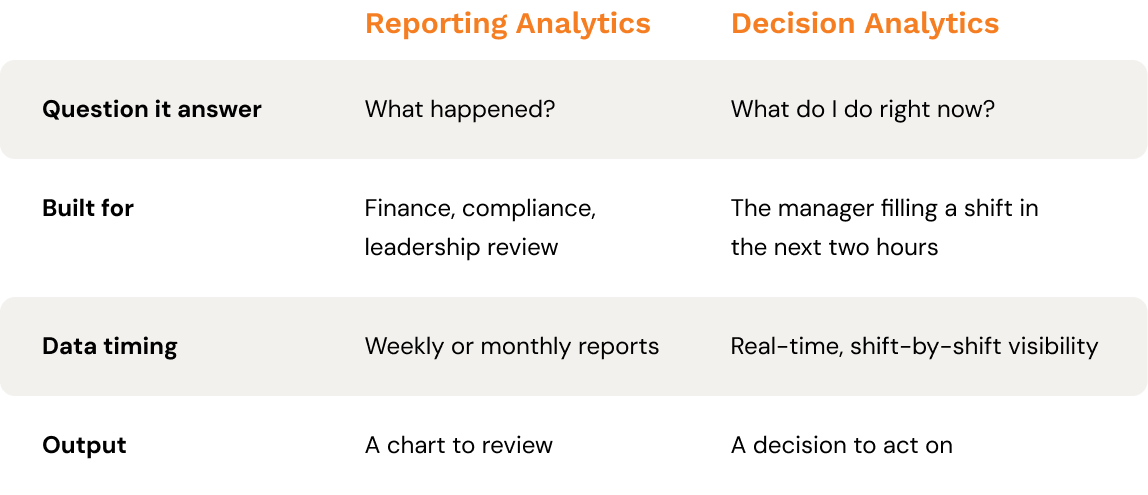
Reporting analytics has genuine value. It’s how CFOs track healthcare labor and spend management over time. It’s how leadership does healthcare workforce planning at a system level.
But reporting analytics cannot help a manager who needs to know right now whether her unit is covered. That requires a different kind of healthcare workforce intelligence, one that is built for real-time decisions.
Reporting analytics tells you what happened. Decision intelligence tells you what to do next. Most platforms only do one.
Why More Data Isn’t the Answer
Enterprise workforce platforms tend to solve the wrong problem. The more you pay, the more complex the analytics get. More filters. More dimensions. More views. More configuration.
It doesn’t help at 5:45am.
If getting a useful answer is too complex, the manager won’t use it. She’ll call the agency. Because the agency picks up the phone.
The right measure for healthcare workforce analytics isn’t feature count. It’s this:
Can the manager get the answer she needs in under 60 seconds, without help, on the worst morning of the week?
That’s the bar. Most enterprise platforms don’t meet it.
94% of healthcare leaders say workforce technology integration is “incredibly difficult.” complexity that was meant to add value becomes a barrier to using it
Test Your Analytics Right Now
Ask your nurse managers these four questions. Their answers will tell you more than any vendor demo.
- Can you see which shifts in the next 72 hours are at risk — right now, without pulling a report?
- When a shift opens, does your system surface available float pool staff — or do you start calling down a list?
- After you fill a shift through an agency, does your system show you what that cost vs. an internal fill?
- Can you see whether your unit’s staffing decisions this week are trending toward or away from budget?
If more than two answers are no, your analytics are not helping your manager. And that gap is showing up directly in your agency spend.
What the Right Analytics Actually Looks Like
Decision-grade healthcare workforce analytics is about three things:
- Visibility. Real-time healthcare workforce visibility across all labor types — internal, float, contract, and on-demand. Shift risk is surfaced before a gap opens.
- Intelligence. Workforce intelligence that recommends an action — fill this shift from your float pool before you call an agency.
- Labor control. Healthcare labor spend management at the point of decision, not in the monthly close. Cost impact visible when it can still change the outcome.
When your analytics solution is built this way, managers use it. When managers use it, internal capacity gets used first, and the agency call stops being the default. Spend comes down because the right information was in the right place at the right time.
That’s the connection between healthcare workforce analytics and real labor cost reduction.
What Definity Does
Most workforce platforms give you data about your workforce. Definity gives you intelligence about your next decision so healthcare labor spend management happens at the point of decision.
This is the difference between hospital staffing analytics that describe a problem and workforce intelligence that helps you solve one.
Definity was developed in partnership with some of the nation’s leading health systems to address their workforce challenges. The result is genuine healthcare workforce visibility: a single view of your total labor picture that gives managers the confidence to act and gives finance the data to plan.
That’s not a dashboard. That’s labor control.