

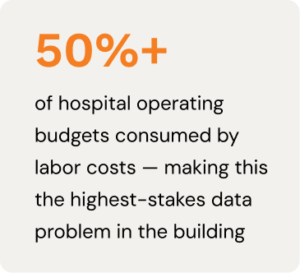
Every health system leader we talk to describes the same experience: they have more workforce technology than ever before, they’re spending more on labor than ever before, and they have less confidence in their workforce decisions than they did ten years ago.
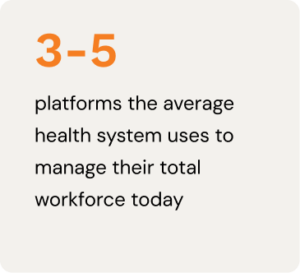
Healthcare workforce management is a patchwork of point solutions, each built for a single labor category, none designed to work together, all generating data that sits in its own silo and serves its own limited purpose.
We built Definity because we watched this problem in real health systems for years. And we built it the way we did to be a fundamentally different architecture.
Why Point Solutions Can’t Solve a Systems Problem
When workforce management breaks down, the instinct is to find a better tool for the specific category that’s failing.
Fill rates are declining? Add a new VMS feature.
Internal float pool is underutilized? Implement a new scheduling module.
Premium labor costs are spiking? Bring in a gig platform.
The answer isn’t another point solution. It’s a system where everything connects.
The health systems making the most progress on labor cost reduction aren’t the ones who found a better ATS or a better VMS. They’re the ones who stopped treating their workforce as three separate problems.
What a Unified Workforce Ecosystem Actually Means
A truly unified system means:
- One source of truth. Every worker — internal, contingent, and on-demand — lives in the same system, with the same definitions. No reconciling. No guessing.
- Side-by-side decisions. When a shift opens, internal and agency options surface together in one view, so you’re always comparing apples to apples.
- Fits your existing stack. It connects to your EHR, HRIS, scheduling, and timekeeping tools. You don’t rebuild around it — it works with what you have.
- Data you can trust. Cost, performance, and coverage all come from the same system, so your comparisons actually mean something.
- Built for how people work. Mobile-first for clinicians, recruiters, schedulers, and vendors — not a desktop tool squeezed onto a phone.
Connect Your Systems. Control Your Outcomes.
The platform only works if every agency competes on equal footing. That’s not a constraint — it’s the point.
When a platform has a financial stake in where volume goes, the data can’t be trusted. Scorecards get skewed. The best performers don’t get rewarded because the system isn’t designed to surface them.
Definity was built by people who know staffing from the inside. Every agency in your vendor pool operates on the same workflows, the same data, and the same performance standards. No thumb on the scale.
When the data is clean and consistent, your best agency relationships become obvious — and so does the case for investing in them.
When every agency competes on the same data, the best performers win more volume. That’s not just good for health systems — it’s good for the agencies who deliver.
See It Now. Get Ahead of What’s Next.
Definity gives workforce leaders a single real-time view of their entire labor landscape — something most health systems can only get today through a manual pull across multiple systems.
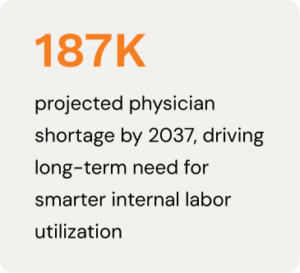
That’s just the starting point. The next step is predictive: knowing which units are trending toward a coverage gap before it opens, with enough lead time to act.
The health systems investing in that capability now won’t be reacting to problems. They’ll be solving them before they happen.
The goal isn’t to see your workforce more clearly. The goal is to see it early enough to act before it costs you more money.
Why Now
The pressure is real. CFOs need to defend every labor dollar. CNOs want to know internal options were exhausted before calling an agency. CIOs are done managing five systems that don’t talk to each other.
The health systems getting ahead of this aren’t spending more – they’re finally seeing what they’re already spending, where it’s going, and what they can do about it. That starts with having everything in one place.
Definity brings your ATS, VMS, and gig workforce into a single platform so the data that used to live in five systems, three spreadsheets, and a Friday afternoon email is now one view, in real time, that everyone can act on.
That infrastructure starts with a simple question: do we have a unified view of our total workforce?
For most health systems today, the answer is no. Definity exists to change that answer.